This product grows through people, not ads. When you share it with someone drowning in subscriptions or stuck in shallow ideas, you help keep this model alive and honest.
Use It
Actually use the prompts. Push your thinking. Build something real. When the output matters, the product improves — and the cycle continues.
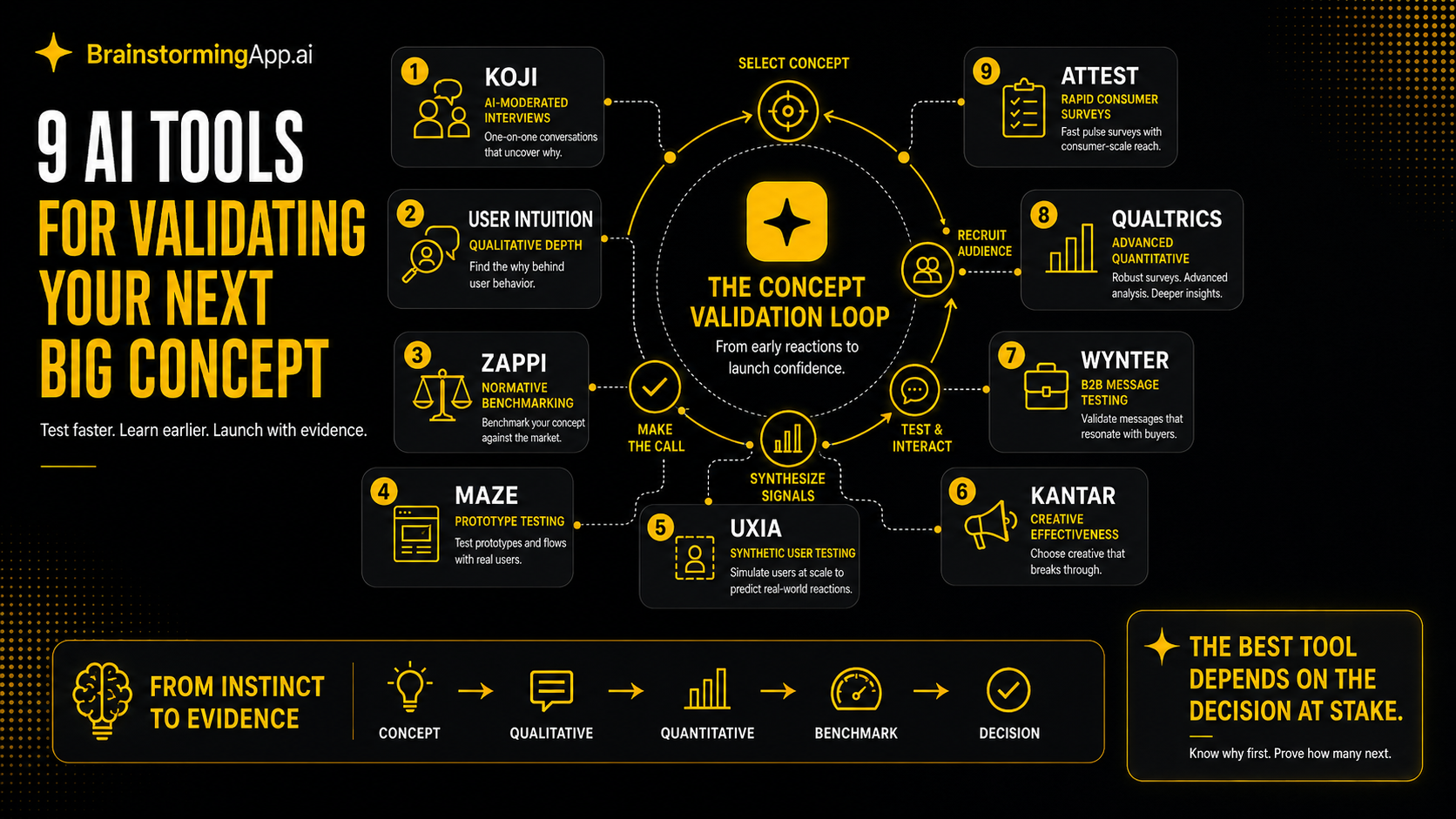
Concept testing often creates a bottleneck between ideation and production. These tools use AI to moderate interviews, simulate user behavior, and provide normative benchmarks to ensure your strategy is backed by data before you spend on execution.
August 24, 2026
Like
Comment
Most creative concepts die in a conference room because they weren't tested against reality fast enough. Traditional market research often takes weeks to recruit participants and code transcripts, forcing teams to rely on gut instinct just to hit a deadline. AI-driven testing platforms change this by automating the heavy lifting of moderation and data synthesis.
Concept testing is no longer a choice between fast and good. The latest tools use AI to conduct thousands of simultaneous interviews or simulate user behavior against historical benchmarks in hours. This allows agencies to back their pitch with evidence before the client even sees the first draft.
Koji specializes in AI-moderated interviews that go deeper than standard surveys. Its AI agent conducts voice or chat sessions, probing participant reactions in real time to understand why a concept resonates. Starting at €29 per month, it is an accessible entry point for small teams, though it requires a clear set of initial questions to guide the AI moderator effectively.
This platform provides AI-moderated qualitative depth with a focus on why concepts fail or succeed. At $25 per interview, it produces 30-minute deep dives in roughly 24 hours. The primary trade-off is the cost per participant, which scales quickly if you need high-volume quantitative proof.
Zappi is built for consumer packaged goods teams that need to compare concepts against historical industry norms. It provides automated quantitative scoring to see how an idea stacks up against competitors before launch. It is an enterprise-grade tool, meaning the pricing is significantly higher than self-serve interview apps.
Maze is the standard for product and design teams who work within Figma. It allows you to run unmoderated tests on prototypes to validate usability and concept appeal before a single line of code is written. While fast, its built-in panel is primarily consumer-oriented, which may not fit niche B2B needs.
Uxia takes a different approach by using synthetic AI users to simulate think-aloud testing and heatmaps. This removes the need for participant recruitment entirely, providing instant feedback on visual flows and messaging. The limitation is that synthetic users cannot perfectly replicate the unpredictable emotional responses of actual humans in every context.
For advertising and brand teams, Kantar offers the LINK suite to test creative effectiveness across TV and digital channels. It relies on a massive database of validated norms to predict how an ad will perform in the real world. This is high-rigor research designed for big budgets and carries a matching enterprise price tag.
Wynter targets B2B companies that need to test messaging and positioning with verified professionals. It solves the data quality problem of general panels by ensuring the feedback comes from people in specific job roles. Because of this specialized audience, it costs more per response than general consumer survey tools.
Qualtrics provides the highest level of statistical rigor for enterprise-level concept testing. It includes advanced methods like conjoint analysis and Van Westendorp pricing models to determine the exact value of a new feature. Its complexity is its main drawback; teams will likely need a dedicated researcher to navigate the platform's steep learning curve.
Attest focuses on speed and affordability for consumer-facing brands that need fast survey data. It allows teams to access a massive global audience and get results back in hours rather than days. It lacks the qualitative depth of AI-moderated interviews, making it better for broad sentiment checks than deep psychological insights.
Choosing a tool depends on whether you need to know how many people like an idea or why they like it. Start with qualitative AI interviews if the concept is still fuzzy, and move toward benchmarking tools like Zappi or Qualtrics when you need hard numbers to justify a launch.
 Donate: