Strategists are currently drowning in data but starving for insights. The role has shifted from finding information to filtering signals, as the sheer volume of available market data makes it impossible to process manually. Most generic AI assistants produce bland, middle-of-the-road summaries that don't help a team win a pitch or solve a complex business problem.
The tools that actually matter in an agency environment are the ones that shorten the distance between a raw brief and a sharp creative angle. These applications focus on specific parts of the strategic workflow: audience mapping, competitive analysis, and structured ideation. They are utility players, not replacements for the intuition required to find a brand's unique voice.
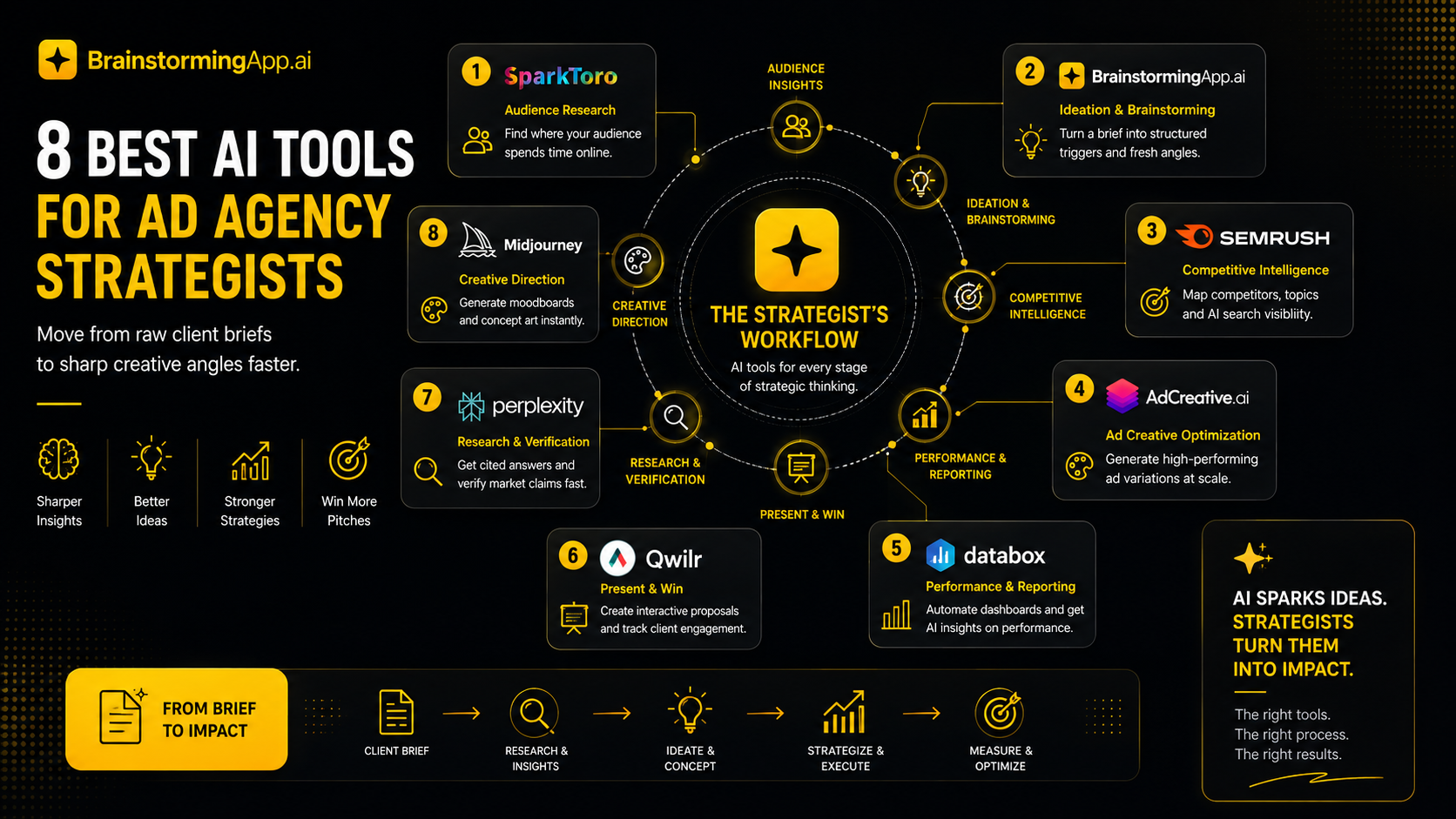
SparkToro identifies exactly where a target audience spends time online without relying on invasive tracking cookies. Strategists use it to map out influencer outreach and media placements by seeing which podcasts, websites, and social accounts their specific audience actually follows. The personal plan starts at $38 monthly, though the data gets weaker when you try to research very small, niche industries with limited digital footprints.
BrainstormingApp.ai takes a client brief and returns structured clusters of brainstorming triggers. It is built to get agency teams moving past the blank-page phase by providing specific, sharp prompts rather than generic advice. It is not a project management suite or a transcription tool, so it won't help with the logistics of the meeting itself. It serves one purpose: generating the initial sparks that lead to a coherent creative strategy.
While often seen as a pure SEO tool, the Semrush Topic Finder and AI Article Generator are useful for mapping out the competitive landscape. Strategists use the platform to track AI search visibility, which is becoming a critical metric as more users move toward AI-powered browsers. Plans start at $129 per month, which is a significant investment for smaller teams, but the depth of competitor data is hard to replicate elsewhere.
This platform uses historical performance data to generate ad variations that focus on audience pain points. It is most effective for performance strategists who need to test dozens of static variations to find the best conversion path. The premium plans start at $44 monthly. The limitation is the aesthetic; because the tool prioritizes conversion data, the output can sometimes feel formulaic compared to high-concept brand campaigns.
Most agencies lose hours on manual reporting, but Databox automates the process with multi-client dashboards and AI-powered performance summaries. It connects to various marketing sources to explain trends and suggest the next logical steps for a campaign. Since sunsetting its free plan in 2025, the tool requires a paid subscription, with the professional tier starting at $159 per month.
Strategists often win or lose based on how they present their ideas, and Qwilr turns standard proposals into interactive web pages with built-in analytics. You can track which sections a client spent the most time on, allowing you to tailor your follow-up conversations to their actual interests. It starts at $35 per person monthly, though it won't fix a weak strategy or a poorly positioned offer.
Perplexity serves as a more reliable research assistant than standard search engines because it cites its sources directly. This makes it easier for strategists to verify market claims and find real-world examples to include in their pitch decks. The pro plan costs $20 monthly, and while it is excellent for gathering facts, it still requires a human to connect those facts into a compelling narrative.
Visual strategy requires more than just words, and Midjourney remains the standard for generating moodboards and concept art. It allows a strategist to show a visual direction for a photoshoot or a campaign before a designer is even briefed. The main tradeoff is the learning curve; mastering the specific prompting language required for high-quality visual outputs takes more time than most button-based design tools.
Choosing the right stack depends on your specific output. If your days are spent in deep research, focus on SparkToro and Perplexity. If you are responsible for leading the creative team into a new campaign, prioritize the ideation triggers and visual concepting tools to get the room moving.
 Donate: